Start with the hotel’s street address
A flight confirmation tells you which airport you are flying into. A hotel confirmation tells you which building you need to reach. Neither tells the massage provider where to meet you unless you pass on the right detail. Start by copying the hotel’s full name and street address from your reservation. Include the city and postal code if they are shown. A property name containing “Toronto Airport” or “Pearson” is useful as a search term, but two names can sound alike when read aloud over a phone call. The street address gives both people something concrete to compare.
Check the address against the message from the provider before you leave the terminal. If they repeat back a different street or mention a hotel feature that does not match your booking, pause and resolve the mismatch. Do the same if your airline, travel coordinator or booking agent has switched your hotel. A reservation amendment can leave the old property name in your email history. Read from the latest confirmation and tell the provider explicitly which address replaces the earlier one. A good message closes the loop by asking the provider to acknowledge the corrected location.
Separate the address from the meeting point. The address identifies the property. The meeting point might be the main lobby, the front desk or another entrance the hotel instructs visitors to use. If the property has a conference entrance or more than one porte-cochère, ask the hotel which door is appropriate. Add that instruction as a separate line. Then ask the provider what they want you to do on arrival, such as waiting in the lobby and sending a message once you are there.
Work out whether you need Terminal Link or a hotel shuttle
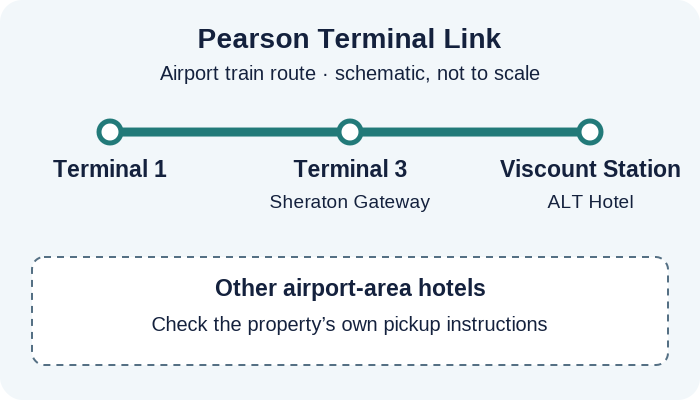
Pearson’s Terminal Link connects Terminal 1, Terminal 3 and Viscount Station. Pearson identifies the Sheraton Gateway Hotel with Terminal 3 and the ALT Hotel with Viscount Station. These are examples of destinations on the Terminal Link route. They do not establish how to get to a different hotel that happens to use the words “airport hotel.” For a hotel outside that route, ask the property for its current pickup instructions or use another transport option that meets your needs. The hotel’s answer should identify the place to wait, not merely the name of the service.
If the hotel says it operates a shuttle, ask whether the instructions differ by terminal. Tell the hotel whether you are arriving at Terminal 1 or Terminal 3 and whether you will be at arrivals with checked baggage. Ask whether the pickup point has a level, door or post number and whether the shuttle runs on request or on a schedule. Follow the airport’s current signs and the hotel’s confirmation. If a driver calls with a different location, ask them to repeat the terminal and level before you start moving. “Door five” is incomplete if two people are picturing different levels.
Some trips are simple enough that the difference feels academic until the passenger is tired, carrying luggage or managing a low phone battery. Put the route in one line on your phone while you still have a connection. It might read “Terminal 3 arrivals → hotel shuttle pickup confirmed by hotel → property’s main lobby.” For an airport-linked property, it might instead read “Terminal 1 → Terminal Link → Viscount → hotel entrance.” The sequence lets you see immediately which instruction belongs to the airport and which belongs to the hotel.
Build your arrival window from the part you can control
Your scheduled landing time is a poor appointment start time. Even a flight that touches down on schedule still has to reach the gate. You may then have to clear border formalities, collect luggage or wait for mobility assistance. From there you still have to reach the hotel and follow its visitor-access process. Build the appointment from the earliest point when you can reasonably be available at the hotel. If you cannot estimate that yet, agree on when you will confirm. Let the provider know which step is uncertain so they can decide whether the timing works for their travel.
A practical checkpoint is the moment you are actually ready to leave the terminal or have confirmed your next ride. At that point you can give a better estimate than the flight tracker can. If you are travelling with someone, agree who will send updates and who will keep an eye on bags or directions. Avoid having one person text the provider while another makes a separate arrangement. One contact person and one thread are enough for a straightforward handoff.
Use Toronto local time in the message. If the trip crosses midnight, write the calendar date next to the proposed time. For example, “I expect to reach the hotel lobby between 12:30 and 12:50 am on Tuesday, November 10, Toronto time.” If the provider can only offer a firm time, ask when they need your confirmation. Then make a realistic choice about whether you can commit. An arrival window is useful for planning. It becomes a booking only after both sides confirm the actual appointment terms.
Set a cutoff before the provider starts travelling
When an appointment depends on a transfer, agree on a time to make the decision. Work backward from when the provider would need to leave. If they need a clear answer by 8:30 pm, make 8:30 the point at which you confirm, move or release the time. Ask what happens if you are still waiting at the airport then, and get the answer before agreeing to a slot. You can keep the discussion simple by asking who should send the next message and what the message needs to say.
A delay has different consequences depending on where it happens. If you are still waiting at the baggage belt, there may be several steps left before the hotel. If you are already in the shuttle and the hotel is the next stop, the uncertainty is smaller. Tell the provider where you actually are, what remains and whether your original finish deadline still applies. If it is too early for a new estimate, say when you can give one. A precise status is more useful than sending “almost there” three times in a row.
Discuss any deposit, travel charge or cancellation term before the provider sets out. Ask what changes if the booking moves after travel begins, or if the hotel cannot permit the visit. If the provider offers a shorter appointment to keep your original finish time, get the new duration and total in writing. There is no need to renegotiate every detail in a hurry if the possible outcomes were discussed while both sides had time to choose.
Resolve hotel access as a separate question
A completed transfer solves the trip from the terminal to the hotel. It does not resolve whether the hotel allows an outside provider to visit or where that person can meet you. Ask the hotel what it permits and whether a registered guest has to accompany a visitor from the lobby. If hotel staff give you a specific process, tell the provider what they should expect before they travel. Keep the directions factual. For example, identify the door and the agreed meeting point, and say who will be present at the front desk.
If you need a step-free path, ask about the entire route from the vehicle drop-off or station to the lobby, and from the lobby to the agreed room or meeting space. A building may have a working elevator yet still require a different outside entrance. A shuttle may have a luggage bay without having the boarding arrangement you need. Ask the airport, shuttle operator or hotel the question that belongs to that part of the trip. A general statement about accessibility does not tell you which door to take with a mobility aid or a large suitcase.
Wait until the location and access are confirmed before sharing any private entry details the provider actually needs. A full street address and an agreed lobby are often enough for planning. If hotel policy prevents the visit, ask about a later time, a permitted alternative or cancellation under the agreed terms. The useful question is which plan both sides can actually follow. Changing to a different property or entrance starts the location check again.
For a return flight, set the finish time first
If you have to be back at Pearson that evening or early the next morning, establish the time you need to be at the terminal using your airline and airport information. Then work backward through the hotel departure, pickup point and travel margin. Only after that should you compare possible appointment start times and durations. Your latest safe time to leave the hotel is more useful in a booking conversation than the flight departure time by itself. The provider can tell you which session duration, if any, fits before that point.
Confirm the departure terminal separately from the one you arrived at. A different flight, carrier or itinerary can change the trip back. If you intend to use a hotel shuttle, ask the property how to reserve it and where to wait. If you intend to use Terminal Link from an airport-linked property, check the current route and allow for walking and the time it takes to reach the departure area. These are different transfer plans. Your appointment should finish early enough for the one you will actually use.
Leave room for ordinary closing steps such as settling payment, collecting your belongings and reaching the lobby. If a ride is already scheduled, give the provider the time you need to be walking out of the room, rather than the time your car is due outside. If the numbers are close before you account for delays, choose a shorter option or a different day. A plan with a little margin is easier to follow than one that works only if every step finishes exactly on time.
Use one message the provider can confirm line by line
After checking the transfer, send a short written summary. For example, “I’m arriving at Pearson Terminal 3 and going to [hotel name, full address]. The hotel confirmed [transfer method and pickup point]. I can confirm my lobby arrival by [date and time in Toronto]. The hotel asks visitors to meet guests at [meeting point]. Can you confirm availability, start and finish time, the total, and what happens if I miss the confirmation cutoff?” If you have a departure deadline, add the time you must leave the hotel.
When the reply arrives, compare it against your note. Make sure the property, date, start time, duration, total and meeting point all match. Ask for any missing item individually. If the message only says “see you at the airport hotel,” reply with the address and ask for agreement. Save the final confirmation in one place, separate from the airport transfer directions. You should be able to read the address while walking and find the full booking terms when you have a minute to stop.
Before heading from the terminal to the hotel, check the three points that can still change: your next pickup or train stop, the person you are meeting and the latest time to confirm. Update the provider if any of those changes. Once you have a correct address, an agreed lobby and a time both sides can keep, the journey and the appointment finally describe the same plan.
Keep a fallback for a missed pickup
Before leaving the baggage area, save the hotel’s transfer instructions and the address in a form you can read offline. If the pickup does not happen as expected, check with the hotel before leaving the agreed waiting point. Find out whether the vehicle is delayed, whether you are at the correct door and when the next pickup is possible. If a different ride is the better choice, let the provider know that the transfer has changed and say when you can give a revised arrival time. Keep the destination address the same unless the hotel booking itself changed.
If you arrive early and the lobby is available, use that time to confirm the meeting process with the desk. If you arrive late, tell the provider before asking to compress the session. The decision may depend on whether they have already travelled and whether you still have time for the service you requested. Save their answer with your original booking details. When the fallback has a clear time, place and cost, you can decide whether to keep the appointment without trying to solve airport directions and booking terms in the same message.